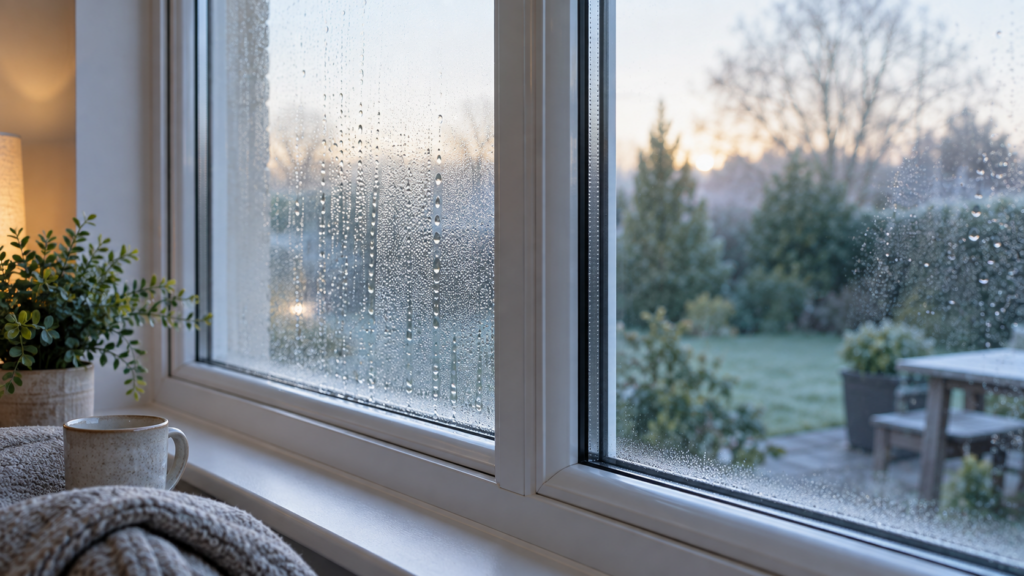
Window condensation does not always mean that the window has failed. The location of the moisture is the most useful clue. Condensation on the room-side surface, dew on the exterior surface, and fog trapped between panes develop for different reasons and call for different responses.
This guide explains how to tell those conditions apart without dismantling the window. If the haze cannot be reached from either side of the glass, read our related guide about fog between window panes and insulated-glass seal failure.
Quick comparison: where is the condensation?
- Inside surface: Moisture is on the glass facing the room and can be wiped away from indoors.
- Outside surface: Moisture is on the exterior face and can normally be wiped away from outside when safely accessible.
- Between panes: The cloudy area remains after both accessible surfaces are cleaned because it is enclosed inside the insulated-glass unit.
The first two conditions are surface condensation. The third generally indicates that moisture has entered a sealed space that normal cleaning cannot reach.
Why condensation forms on glass
Air can hold water vapor, but the amount it can hold changes with temperature. When humid air meets a surface cold enough to reach the dew point, some of that vapor becomes liquid water. Window glass often shows this first because its surface temperature may differ from the surrounding walls and room air.
Condensation is therefore influenced by several conditions at once: indoor or outdoor humidity, glass temperature, weather, ventilation, insulation, air movement, and the thermal performance of the window. A small amount appearing briefly does not identify a defect by itself.
What interior window condensation means
Interior condensation appears on the surface facing the room. It is common when indoor air contains substantial moisture and the inside glass becomes cold enough for water to collect. Cooking, showering, drying laundry indoors, many occupants, aquariums, humidifiers, and unvented combustion appliances can all add moisture to indoor air.
The pattern may be strongest overnight or early in the morning, especially during cold weather. Water can collect near the lower edge because cooler air falls along the glass and droplets run downward. Curtains, blinds, or furniture that restrict warm room air from reaching the window may also make the glass cooler.
Persistent water should not be ignored. Repeated wetting can damage paint, wood, drywall, seals, and nearby finishes even when the insulated-glass seal remains intact.
What exterior window condensation means
Exterior condensation forms on the outdoor surface when that glass becomes cooler than humid outside air. It often appears during clear, calm mornings when surfaces lose heat overnight and outdoor humidity is high.
This condition can occur on well-insulated windows because less indoor heat reaches the exterior pane to warm it. Exterior dew alone is therefore not reliable evidence that the window is defective. Sunlight, rising outdoor temperatures, or normal air movement often clears it naturally.
Do not lean from a window or use an unsafe ladder merely to wipe exterior condensation. Its location can often be confirmed by observing whether it changes after sunlight reaches the glass.
How condensation between panes is different
Double-pane and triple-pane windows contain a sealed insulating-glass unit, commonly called an IGU. If moisture enters that sealed cavity, fog, streaks, droplets, or mineral deposits may appear on internal glass surfaces.
Unlike ordinary surface condensation, this haze cannot be wiped away from the room side or the exterior side. Its appearance may change with temperature and weather, but the inaccessible location is the important distinction.
Lowering indoor humidity may reduce room-side condensation. It will not remove water or deposits already trapped inside a failed sealed unit. Adding caulk around the visible sash edge also does not rebuild the factory-sealed cavity.
A safe step-by-step location test
- Use a clean, dry cloth indoors. Wipe the suspected area on the room-side surface. If it clears or changes, the moisture is indoors.
- Observe the exterior safely. Check from ground level or another secure position. Do not climb or reach beyond a safe working area.
- Compare the pattern over time. Record whether it appears after showers, cooking, cold nights, humid mornings, rainfall, or direct sunlight.
- Clean accessible surfaces normally. Residue and cleaning film can resemble haze, so use a glass-safe method recommended for the product.
- Look for an enclosed appearance. If the same cloudy area remains unchanged after both accessible faces are clean, it is probably between the panes.
A flashlight held at an angle may help reveal which surface carries droplets or residue. Do not insert tools into glazing joints, remove stops, pry apart a sash, or drill the glass to perform this test.
Ways to reduce room-side condensation
If moisture is on the indoor surface, begin by controlling the conditions producing it. Use functioning exhaust fans while cooking and bathing, vent moisture-producing appliances as designed, and avoid running a humidifier above the level appropriate for current weather.
Allow conditioned room air to reach the glass by opening blinds or curtains when practical. Check that supply and return vents are not blocked. A portable humidity meter can help show whether changes in household activity correspond with higher indoor humidity.
Reducing humidity should be done reasonably rather than trying to make the home excessively dry. The suitable level varies with outdoor temperature, building construction, comfort, and local conditions. Persistent widespread moisture may require evaluation of ventilation, insulation, or water intrusion rather than attention to the window alone.
When the window needs further inspection
Arrange professional evaluation when condensation is accompanied by active leakage, rotten or swollen materials, damaged glazing, loose glass, severe mold-like growth, or a sash that no longer operates safely. Water appearing around a window during rain may come from an installation, flashing, drainage, wall, or roof problem rather than condensation.
For suspected fog between panes, identify the manufacturer and product before ordering work. The failed insulated-glass unit or sash may be replaceable without replacing the complete frame. Warranty coverage and compatible parts can affect the practical choice.
What to photograph before requesting service
Take a wide photograph of the whole window and close views of the moisture pattern. Photograph the condition at different times if it changes. Include any manufacturer label, code etched into the glass, spacer markings, frame damage, staining, or standing water.
Tell the service provider whether the moisture wipes away indoors, appears outdoors only, or remains inaccessible. That detail can prevent a surface-humidity issue from being mistaken for a failed glass seal—or the reverse.
The practical conclusion
Condensation on an accessible glass surface is usually a dew-point and humidity condition. Interior moisture points toward indoor humidity, cold glass, or limited ventilation around the window. Exterior dew commonly reflects humid outdoor air meeting cool exterior glass.
Fog that remains after both accessible surfaces are clean is different: it strongly suggests moisture inside the insulated-glass unit. Confirm the location first, address indoor moisture when appropriate, and base any repair on the component that has actually failed.